An AI visibility audit tells a solo operator whether an AI answer engine can discover, parse, verify and safely cite the page that supports a sale. It is not a ranking forecast and it does not need a giant dashboard. It is a short evidence loop: test a buyer question, record what appears, identify the blocked layer, fix that layer, and test again.
The goal is not a vague visibility score. It is to prevent a qualified buyer from asking an AI for help, receiving a useful answer, and never seeing the business that could solve the problem. For a phone-first operator, that is an income-exposure problem before it is an SEO problem.
What this audit answers — and what it does not
This guide is the companion method for the free Run the 60-second exposure audit. The free check sorts exposure quickly. The method below shows what to test next when the result says a layer needs attention.
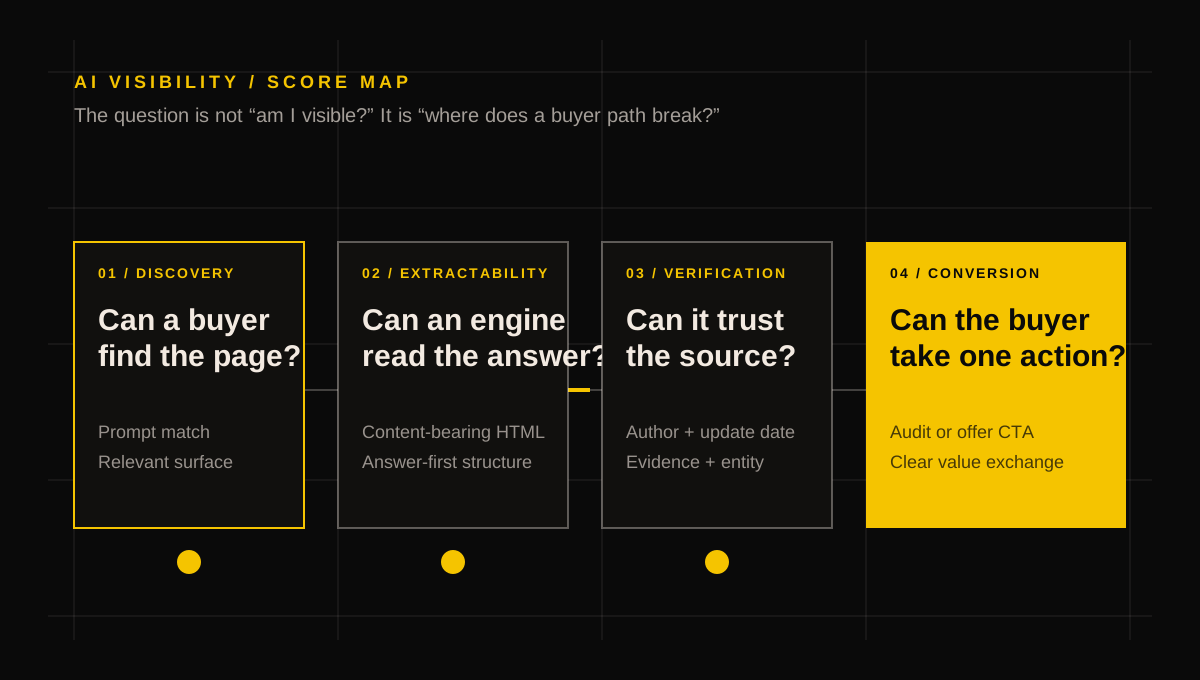
It answers four practical questions:
- Can a buyer-facing page be crawled and rendered?
- Can an engine extract a direct answer from that page?
- Can it verify who published the answer and why it is trustworthy?
- Does the page route a qualified reader to one useful next action?
It does not prove a future ranking, estimate traffic, or promise that a change will create sales. AI answer engines change, citations vary by query, and a small site starts with little historic authority. Use the process to remove preventable blindness, then measure whether real buyer prompts start producing a better result.
The seven-step AI visibility method
1. Name the revenue question before opening a tool
Start with one page, one offer and one buyer question. “How do I get more AI traffic?” is too broad. “What should a solo consultant check before AI answers replace the page that sells their audit?” is narrow enough to test.
Write the question in buyer language, then name one business action it should lead to: read a guide, run an audit, request a quote, or buy a kit. If the action is unclear, fix the offer page before improving the citation layer.
2. Run the 12-question exposure check
Use the short audit to locate the most exposed layer before you open a spreadsheet. It takes about a minute and does not ask for an email. Run the 60-second exposure audit first; retain the verdict, not just the total.
The 12 questions map to three levels of exposure:
| Check | Question to answer | Why it matters |
|---|---|---|
| 01 | Does a meaningful share of income depend on search discovery? | High dependency turns an access failure into a revenue risk. |
| 02 | Would a buyer lose a clear path if a search click disappeared? | A resilient offer has a second path to action. |
| 03 | Can a visitor understand the offer without brand context? | AI outputs need extractable, self-contained answers. |
| 04 | Does the page state who it helps and what happens next? | A citation without a clear job does not convert. |
| 05 | Is the offer connected to a specific proof or method? | Concrete evidence beats broad claims. |
| 06 | Can search and AI crawlers access the route? | A blocked page cannot be cited. |
| 07 | Does the page render useful content without a client-side wait? | A blank shell is weak evidence for machines and people. |
| 08 | Does the page use relevant structured data honestly? | Schema clarifies the content type and relationships. |
| 09 | Can the business identity be cross-checked? | Consistent entity signals make a source easier to verify. |
| 10 | Does the content answer one buyer question directly? | Answer-first copy gives an engine material to quote. |
| 11 | Is the page current enough for its claim? | Dated sources and visible updates reduce ambiguity. |
| 12 | Can a reader move from evidence to one next action? | The commercial bridge must be explicit, not implied. |
The audit result is a routing decision. A high exposure verdict means repair the first broken layer before publishing more content. A low exposure verdict means keep the baseline and use the prompt tests below to find the next constraint.
3. Test the buyer prompts, not your brand name
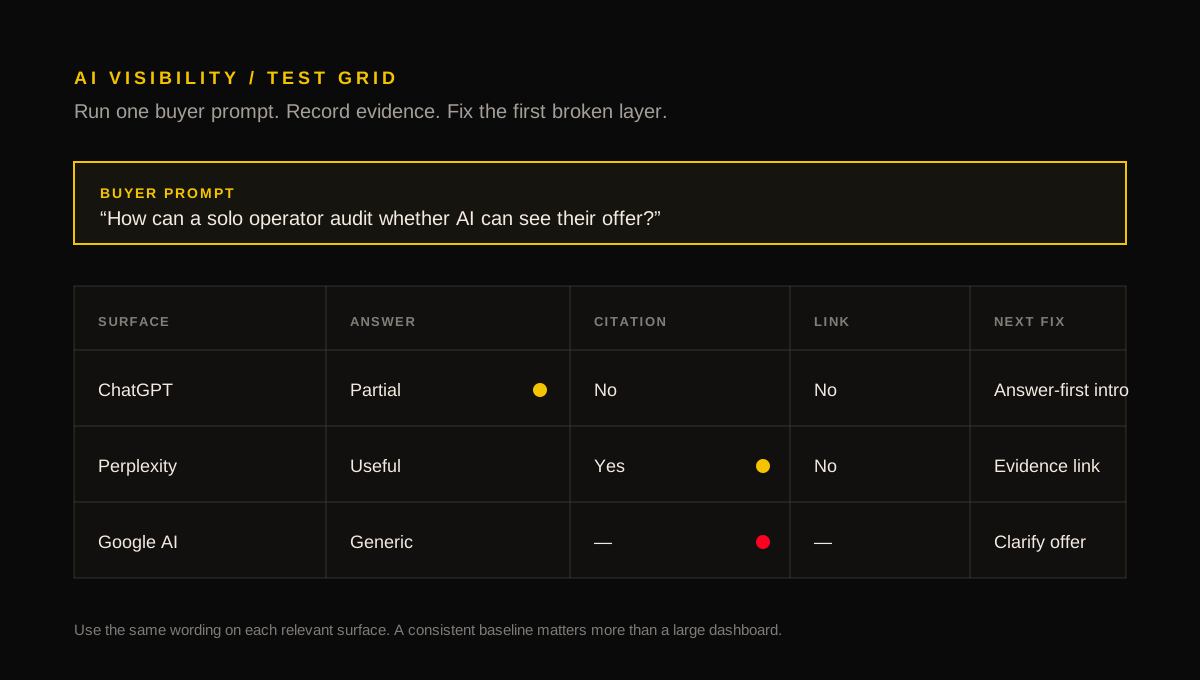
Brand searches measure whether an engine already knows a name. Buyer prompts measure whether it can find the page without brand context. Run the query on AI surfaces your buyers use. Four consistent tests beat a larger, inconsistent sweep.
Use the table as a starting battery. Replace the bracketed parts with the language of the real offer.
| Prompt type | Example question | Platform | Evidence | Next fix |
|---|---|---|---|---|
| Definition | “What is AI search blindness for a solo business?” | ChatGPT or Perplexity | Is a usable definition cited or is the result generic? | Publish a direct two-sentence definition near the top of the guide. |
| Problem diagnosis | “How can a solo operator check whether AI can read their website?” | ChatGPT or Google AI Overviews | Does the answer name a practical method or send the buyer elsewhere? | Add a short method, checklist and source links. |
| Technical decision | “Does a small site need robots.txt, schema and llms.txt for AI visibility?” | Perplexity or ChatGPT | Are the layers explained without overclaiming? | Clarify crawler access, machine-readable structure and entity evidence separately. |
| Commercial comparison | “What is the fastest way to audit AI visibility without enterprise software?” | ChatGPT or Perplexity | Does the answer expose a no-email self-check option? | Put the audit value proposition and duration above the fold. |
| Buyer action | “How do I fix AI search blindness after an audit?” | ChatGPT or Google AI Overviews | Is a practical next step present? | Connect the audit to the paid implementation asset. |
| Proof question | “What evidence shows AI traffic can expose small publishers?” | Perplexity | Does the answer link to dated, attributable research? | Link the claim to a maintained evidence page rather than repeating a number. |
Record the outcome as not present, mentioned, linked/cited, or wrongly framed, with the prompt, platform and date. That makes the next change measurable.
4. Separate the three failure modes
Most weak results fall into one of three buckets. Do not apply the same fix to all of them.
- Access failure: the crawler cannot reach meaningful content because the route is blocked, empty before JavaScript runs, or absent from the site map. The action is technical: verify
robots.txt, the XML sitemap, initial HTML and real HTTP responses. - Extraction failure: the content is reachable but a machine cannot quickly identify the question, answer, evidence and decision. The action is editorial: write the answer first, use descriptive headings, add one decision table and cite the source behind material claims.
- Verification failure: the page makes a claim, but the publisher or update trail is unclear. The action is trust: name the author, show an update date, link the method to a stable data source, and keep business identity consistent across the site and profiles.
A fourth problem is often mistaken for an AI issue: conversion failure. The answer may be visible, but the visitor does not know what to do next. Solve that with one primary CTA, not a page full of competing buttons.
5. Capture proof on the page itself
The page should carry enough evidence to stand alone. For this site, the evidence layer is the AI Traffic Collapse Index, which keeps the source links and dates behind the traffic-risk context. The audit page stays deliberately short; the long-form method carries the explanation.
For every guide that matters commercially, show:
- a visible author and last-updated date;
- a direct answer in the opening paragraph;
- a dated source or a first-hand proof where a factual claim needs support;
- one table that reduces a decision; and
- a link to the next measurable action.
That is enough for a small operator. Do not add a “research centre” aesthetic without research. A transparent limitation is more credible than a manufactured metric.
6. Fix in revenue order, not technical order
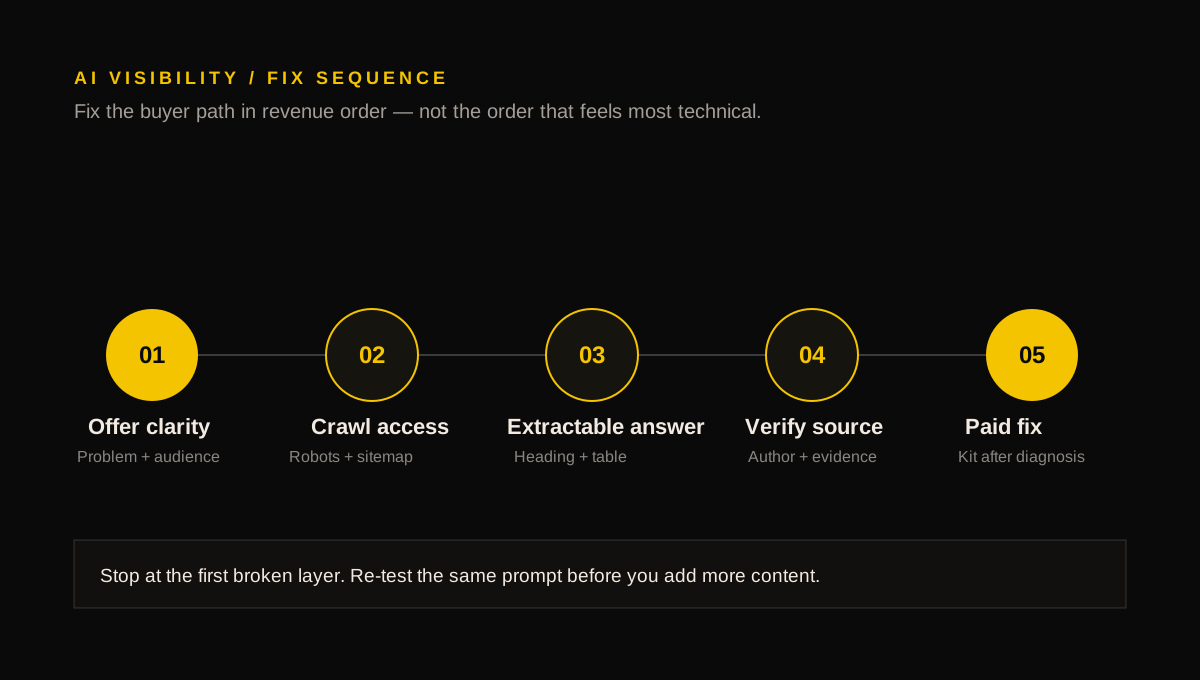
A perfect llms.txt does not help if the offer page cannot explain its own job. A beautifully written guide does not help if the page is blocked from crawling. The correct order is the order that protects the buyer path.
- Make the offer legible. State the problem, audience, method and next action.
- Make the page reachable. Confirm it appears in the sitemap and returns content-bearing HTML.
- Make the answer extractable. Add an answer-first introduction, clear headings and a practical table.
- Make the source verifiable. Add author, update date, source links and truthful JSON-LD.
- Make the fix purchasable. Only after the audit or method has made the gap visible, offer the implementation asset.
7. Re-test the same prompt after the change
Do not celebrate the deployment. Re-run the exact question after the page has been crawled or refreshed. The immediate success condition is not “ranked number one.” It is simpler: the page contains an unambiguous answer, an AI-capable crawler can access it, and the qualified visitor has one direct next action.
If the free audit identifies a practical gap, the implementation asset is the AI Search Blindness Fix Kit — $49. It packages the checklists, templates and fix sequence used after the diagnosis. Get the AI Search Blindness Fix Kit — $49 only after the audit has made the relevant exposure clear.
The operator scorecard: one page, one decision
Keep the recurring scorecard light. A note on the phone is enough:
| Date | Buyer prompt | Surface | Outcome | Broken layer | One next move |
|---|---|---|---|---|---|
| 2026-10-11 | “How can a solo operator audit AI visibility?” | Perplexity | Mentioned, not linked | Extraction | Add a direct method table. |
| 2026-10-11 | “Can AI read my offer page?” | ChatGPT | Generic answer | Verification | Add author, update date and evidence path. |
| 2026-10-11 | “How do I fix AI search blindness?” | Google AI Overviews | No meaningful answer | Conversion | Route the method to the free audit and kit. |
Each result becomes either a content improvement, a technical task, or a reason to stop work that does not protect revenue. If two consistent rounds show no movement, narrow the prompt or isolate the offer page before building another cluster.
Sources and scope
The operational context and dated source links behind AI-search traffic risk are maintained in the AI Traffic Collapse Index. This guide does not claim a keyword volume, ranking position or traffic forecast; it finds observable gaps and connects the right fix to a buyer path.
Read the method, run the no-email exposure audit, then decide whether the $49 Fix Kit is the relevant implementation shortcut.
FAQ
- What is an AI visibility audit?
An AI visibility audit is a repeatable check of whether AI answer engines can access, understand, verify and cite the pages that matter to a business. For a solo operator, it should connect directly to a revenue page and a concrete next action rather than a generic awareness score.
- How long does the BEARTH exposure audit take?
The free BEARTH audit takes about 60 seconds for twelve yes-or-no questions and produces an immediate verdict without an email gate. The full method in this guide takes longer because it adds buyer-prompt testing and evidence capture.
- Does structured data guarantee that an AI will cite my site?
No. Structured data can make the page type and relationships clearer, but it does not guarantee a citation or a ranking. It works alongside crawl access, clear on-page answers, source transparency and a credible entity.
- Which AI platforms should a solo operator test?
Test the surfaces that your buyers already use to research the offer. A consistent battery across two to four relevant surfaces is more useful than a broad one-off test across every available model.
- What should I fix first after a critical result?
Fix the first layer that blocks the buyer path: offer clarity, crawl access, extractable answer, verification or conversion. Start with the path that puts the most revenue at risk, then re-run the same prompt to confirm the change.
Written by Saimen Bearth for BEARTH. Last updated 11 October 2026. The free diagnosis is the Traffic-Free Income Audit; the maintained evidence layer is the AI Traffic Collapse Index.