AI visibility is not a single score. It is the pattern you see when a real buyer asks a useful question: whether your offer appears, whether the answer is accurate and whether the system can show a source a buyer can verify. Run five prompts first; do not run all 25 until a decision needs more evidence.
Takeaways
- 01Use prompts a buyer would actually ask
- 02Record answers and citations separately
- 03Fix the first missing layer, then test again
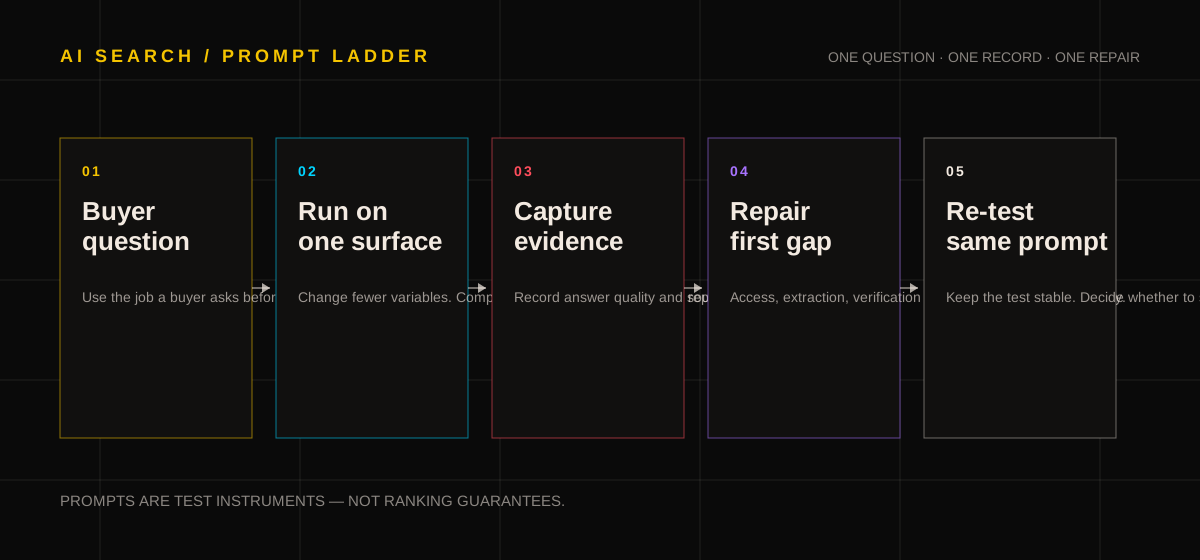
Use the library in 25 minutes
- Replace every bracket with your real category, city, audience or job.
- Pick one intent group that matches the buyer stage you need now.
- Run five prompts across the AI surfaces your buyers already use.
- Record the exact answer, source links and missing layer.
- Make one repair, then repeat the same five prompts.
Do not ask: “Does AI know my brand?” Ask: the decision question your buyer asks before they know your brand exists.
1. Find the buyer language
Use these before writing an offer page, video title or guide. The output is language to verify, not copy to blindly publish.
| # | Prompt | Record | Next move |
|---|---|---|---|
| 01 | What is the fastest way for a [buyer type] to solve [specific job] without [common constraint]? | Exact problem wording | Match the offer headline to the job |
| 02 | What would make a [buyer type] hesitate before buying [category]? | Objections | Add the missing proof or scope |
| 03 | How do people compare [approach A] with [approach B] for [job]? | Decision criteria | Build a comparison section |
| 04 | What does a beginner need before trying [outcome]? | Prerequisites | Publish a short start-here answer |
| 05 | What is a realistic first result from [category] in 7 days? | Outcome language | Remove inflated promises from the offer |
2. Test recommendation visibility
Use these when you want to know whether an unbranded buyer question can surface a relevant offer or source.
| # | Prompt | Record | Next move |
|---|---|---|---|
| 06 | Recommend practical resources for a [buyer type] who needs [job]. Include sources. | Named resources and links | Check whether a source page explains the job |
| 07 | Which small businesses or operators explain [topic] with concrete steps rather than generic advice? | Named entities | Strengthen author and entity links |
| 08 | Where can I find a checklist for [job] that I can use today? | Resource format | Publish the checklist as visible HTML |
| 09 | What should I read before paying for [category]? Cite the best beginner resource. | Cited source | Add scope, author and update date |
| 10 | Give me three ways to solve [job] if I have no team and limited time. | Alternatives and gaps | Position the phone-first constraint clearly |
3. Test answer extraction
Use these to see if the page you have actually answers a narrow question in a way a system can extract without inventing the missing detail.
| # | Prompt | Record | Next move |
|---|---|---|---|
| 11 | What are the first three steps to [job]? | Steps returned | Add a numbered sequence near the top |
| 12 | What is the difference between [term A] and [term B] for a solo business? | Definitions returned | Write a direct comparison block |
| 13 | What should I avoid when [job]? | Failure modes | Add a visible “avoid” section |
| 14 | How long does [job] take for one person? | Time framing | State a realistic time and dependency |
| 15 | What is the smallest useful version of [outcome]? | Minimum viable action | Publish a one-session workflow |
4. Test source and citation readiness
A correct answer without a verifiable source is not strong evidence. Capture the source behaviour separately from the answer quality.
| # | Prompt | Record | Next move |
|---|---|---|---|
| 16 | What sources support the claim that [specific claim]? Link to the source. | Whether sources are shown | Add first-party evidence or reduce the claim |
| 17 | Who has documented a repeatable workflow for [job]? Cite the original source. | Entity and source match | Add a byline and source trail |
| 18 | Which source explains [topic] with a dated checklist? | Dates and freshness | Add updated date and change note |
| 19 | Can you verify this advice: [one sentence from your page]? | Accuracy and caveats | Correct unsupported wording |
| 20 | What should a buyer check before trusting advice about [topic]? | Trust signals | Make scope and limits visible |
5. Test the decision hand-off
These prompts expose the gap between useful content and a clear next action. Use them before adding another CTA or product feature.
| # | Prompt | Record | Next move |
|---|---|---|---|
| 21 | After I understand [topic], what is the next practical action? | Action suggested | Make the primary action explicit |
| 22 | What template or checklist would save time on [job]? | Requested asset | Build or link the implementation asset |
| 23 | When should I pay for help with [job] instead of doing it myself? | Buy-versus-DIY trigger | State the paid outcome and boundary |
| 24 | What is the risk of ignoring [job] for 30 days? | Cost of delay | Use only defensible urgency |
| 25 | What evidence would convince me to choose [offer type]? | Proof required | Add the proof, not more adjectives |
Capture results in one line
Use the same minimal record for every prompt:
| Field | Write only this |
|---|---|
| Buyer prompt | Exact question used |
| Surface | The AI product or search surface used |
| Answer | Useful, incomplete or wrong |
| Source | Shown, absent or irrelevant |
| Missing layer | Access, extraction, verification or conversion |
| Next repair | One page, one edit, one owner |
This is enough to turn a vague “AI does not see me” complaint into an ordered repair queue.
Choose the repair, not more prompts
| If you see this | Do this next |
|---|---|
| The answer cannot find the relevant page | Check crawl access, sitemap and internal links |
| The page is found but the answer is generic | Add a direct definition, steps and a decision table |
| The answer is useful but cannot show a credible source | Add author, date, evidence and entity references |
| The answer names the problem but gives no next action | Put one visible action and one implementation path on the page |
| The answer is wrong | Correct the original source before testing again |
For a quick first pass, use these prompts after the 60-second AI visibility audit. The audit identifies the exposure layer; this library makes the buyer question concrete.
FAQ
- Which AI surfaces should I test?
Start with the surface a real buyer mentions or uses. Do not manufacture a score by testing every tool available. Consistent buyer questions matter more than platform volume.
- Are these prompts guaranteed to produce citations?
No. A prompt is a test instrument, not a ranking guarantee. It helps you observe whether a page can be found, extracted and verified for a specific question.
- How often should I repeat the prompts?
Run the same five-prompt set after a meaningful change to the relevant page. Changing the wording every time destroys the comparison.
- What if the answer is wrong?
Record the exact wording, inspect the source page and fix the original ambiguity or unsupported claim. Do not try to force an answer with more promotional text.
- Can I use the prompt output as customer research?
Use it as a hypothesis generator. Validate language with real buyer conversations, support messages or sales objections before making it the headline of a paid offer.
Updated 11 October 2026. The library is an operator testing framework. It does not claim access to private model rankings, traffic data or citation guarantees.